


- Học kỳ
- SU2026
- Thời Gian
- 10/8/26
- Loại tài liệu
- FE
- Mã Đề
- SSG104_SU26_RE_538339
SSG104_SU26_RE_538339
SSG104 Multiple Choice Questions
This document contains a series of multiple choice questions related to the course SSG104. The topics covered include self-evaluation, power dynamics, social loafing, career roadmaps, and nonverbal communication. It serves as a study or assessment material for students.SSG104 Multiple Choice Questions
SSG104_SU26_RE_538339 - Multiple Choice
Question 1
(Choose 1 answer)
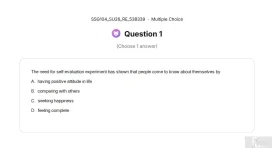
The need for self-evaluation experiment has shown that people come to know about themselves by
A. having positive attitude in life
B. comparing with others
C. seeking happiness
D. feeling complete
Question 2
(Choose 1 answer)
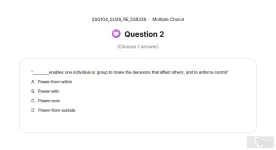
"_____ enables one individual or group to make the decisions that affect others, and to enforce control"
A. Power-from-within
B. Power-with
C. Power-over
D. Power-from-outside
Question 3
(Choose 1 answer)
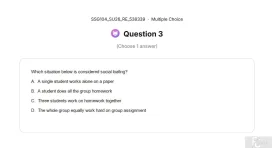
Which situation below is considered social loafing?
A. A single student works alone on a paper
B. A student does all the group homework
C. Three students work on homework together
D. The whole group equally work hard on group assignment
Question 4
(Choose 1 answer)
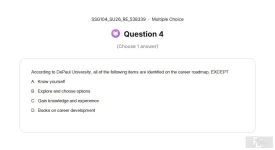
According to DePaul University, all of the following items are identified on the career roadmap, EXCEPT
A. Know yourself
B. Explore and choose options
C. Gain knowledge and experience
D. Books on career development
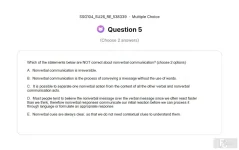
Question 5
(Choose 2 answers)
Which of the statements below are NOT correct about nonverbal communication? (choose 2 options)
A. Nonverbal communication is irreversible.
B. Nonverbal communication is the process of conveying a message without the use of words.
C. It is possible to separate one nonverbal action from the context of all the other verbal and nonverbal communication acts.
D. Most people tend to believe the nonverbal message over the verbal message since we often react faster than we think, therefore nonverbal responses communicate our initial reaction before we can process it through language or formulate an appropriate response.
E. Nonverbal cues are always clear, so that we do not need contextual clues to understand them.
Đính kèm
-
 SSG104 SU26 FE RE_001.webp25.4 KB · Lượt xem: 13
 -
 SSG104 SU26 FE RE_002.webp23.3 KB · Lượt xem: 12
 -
 SSG104 SU26 FE RE_003.webp29 KB · Lượt xem: 9
 -
 SSG104 SU26 FE RE_004.webp27.3 KB · Lượt xem: 7
 -
 SSG104 SU26 FE RE_005.webp60.8 KB · Lượt xem: 8
 -
 SSG104 SU26 FE RE_006.webp19.7 KB · Lượt xem: 5
 -
 SSG104 SU26 FE RE_007.webp63.5 KB · Lượt xem: 4
 -
 SSG104 SU26 FE RE_008.webp48.2 KB · Lượt xem: 5
 -
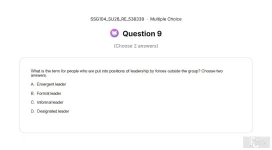 SSG104 SU26 FE RE_009.webp24.7 KB · Lượt xem: 4
 -
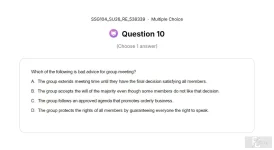 SSG104 SU26 FE RE_010.webp41 KB · Lượt xem: 4
 -
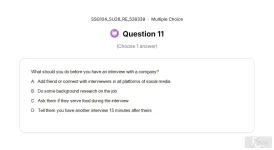 SSG104 SU26 FE RE_011.webp32.6 KB · Lượt xem: 4
 -
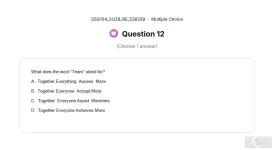 SSG104 SU26 FE RE_012.webp25.2 KB · Lượt xem: 3
 -
 SSG104 SU26 FE RE_013.webp41.4 KB · Lượt xem: 4
 -
 SSG104 SU26 FE RE_014.webp19.4 KB · Lượt xem: 4
 -
 SSG104 SU26 FE RE_015.webp42.4 KB · Lượt xem: 4
 -
 SSG104 SU26 FE RE_016.webp25.7 KB · Lượt xem: 4
 -
 SSG104 SU26 FE RE_017.webp30.9 KB · Lượt xem: 3
 -
 SSG104 SU26 FE RE_018.webp45.1 KB · Lượt xem: 2
 -
 SSG104 SU26 FE RE_019.webp25.5 KB · Lượt xem: 3
 -
 SSG104 SU26 FE RE_020.webp29.8 KB · Lượt xem: 3
 -
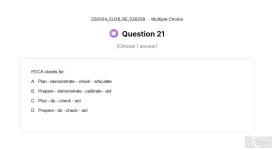 SSG104 SU26 FE RE_021.webp22 KB · Lượt xem: 2
 -
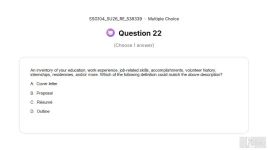 SSG104 SU26 FE RE_022.webp30 KB · Lượt xem: 2
 -
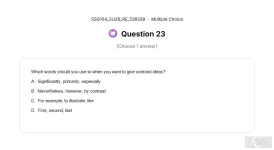 SSG104 SU26 FE RE_023.webp25.8 KB · Lượt xem: 2
 -
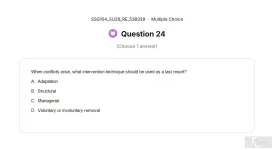 SSG104 SU26 FE RE_024.webp22.8 KB · Lượt xem: 2
 -
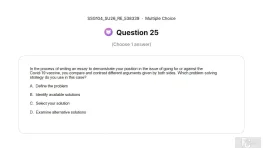 SSG104 SU26 FE RE_025.webp34.9 KB · Lượt xem: 12

